

Herrerasaurus
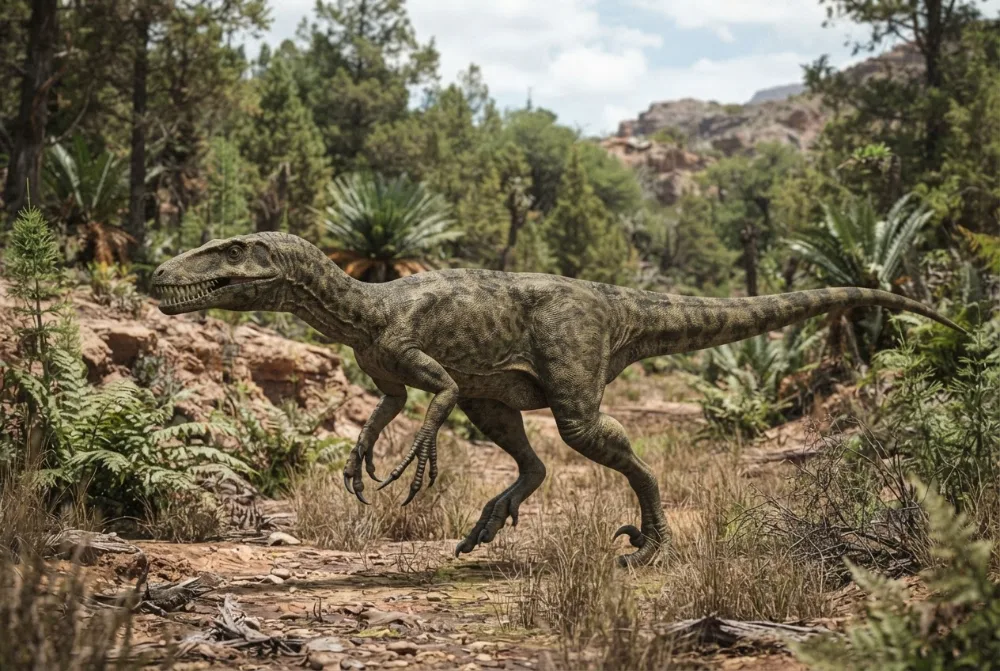
Herrerasaurus was one of the very first dinosaurs. It was a fast, two-legged hunter with sharp claws and teeth. It lived in Argentina about 230 million years ago.14
When did it live?
How big was it?
How long was it?
How heavy was it?
How big was Herrerasaurus compared to YOU?
Just maths in your browser. Nothing is saved or sent anywhere.
Fun facts
Herrerasaurus had a short forelimb that was specialized for grasping and raking, making it a skilled predator.1
It lived during the Carnian age, about 237 to 227 million years ago, which is very early in dinosaur history.4
Some scientists used to think Herrerasaurus was not a true dinosaur, but now most agree it was an early theropod.2
Herrerasaurus is the type genus of the family Herrerasauridae, a group of early meat-eating dinosaurs.2
The first fossils were found in 1963, but a complete skull and skeleton were not unearthed until 1992.14
Herrerasaurus was an agile, bipedal predator, meaning it walked on two legs and was quick on its feet.1
Most asked questions about Herrerasaurus
?How big was Herrerasaurus?
Herrerasaurus was about 6 metres (20 feet) long and weighed around 350 kilograms (770 pounds). Smaller specimens were about 4.5 metres (15 feet) long and weighed about 200 kilograms (440 pounds).3
?What did Herrerasaurus eat?
Herrerasaurus was a carnivore, meaning it ate meat. It had large serrated teeth for biting and eating flesh, and sharp claws for grasping prey.3
?When did Herrerasaurus live?
Herrerasaurus lived during the Late Triassic period, about 231 to 228 million years ago, during the Carnian age. That's very early in dinosaur history.3
?Where was Herrerasaurus found?
Herrerasaurus fossils have been found in the Ischigualasto Formation in northwestern Argentina, South America. The first specimen was discovered in 1958 by a rancher named Victorino Herrera.3
?Was Herrerasaurus a dinosaur?
Yes, Herrerasaurus is considered an early dinosaur. For many years scientists debated whether it was a true dinosaur, but now most agree it was an early saurischian dinosaur, possibly a primitive theropod.3
?How fast could Herrerasaurus run?
Herrerasaurus was likely a swift runner. It had strong hind limbs with short thighs and long feet, and a stiff tail for balance, all adaptations for speed.3
?Did Herrerasaurus have feathers?
The sources do not mention feathers on Herrerasaurus. It lived very early in dinosaur history, and no feather fossils have been found with it.3

Ask Rex about Herrerasaurus
Rex only answers questions about this page. 3 questions a day.
Rex is an AI and can make mistakes. He runs on servers in the EU and questions are never saved. Never type your name or other personal things.
Myth buster
Myth: Some people think Herrerasaurus was a dinosaur like T. rex, but it was much older and more primitive.
Truth: Herrerasaurus was an early dinosaur, but it lived about 230 million years ago, long before T. rex. It had a shorter forelimb and a more primitive body.1
For dino experts
- Scientific name
- Herrerasaurus
- Named by
- Reig 19634
- Group
- First dinosaurs
- Family / clade
- Herrerasauridae4
- Classification
- Herrerasauridae4
- Age of the rocks
- 237 to 227 million years (Carnian)4
- Rock formations
- Ischigualasto4
- Countries
- Argentina4
- Fossil records
- 11 in the Paleobiology Database4
- Also known as
- Frenguellisaurus, Ischisaurus (older names now counted as the same animal)4
- Discovery
- Herrerasaurus was named by Osvaldo Reig in 1963, based on fossils found in Argentina. Later, a complete skull and skeleton were discovered in the Ischigualasto Formation, helping scientists understand its anatomy.41
- Still debated
- Scientists still debate whether Herrerasaurus was a true theropod or a more primitive dinosaur, because it has features of both.2
Where the facts come from
- The Complete Skull and Skeleton of an Early Dinosaur (science.org)
- PBDB Taxon (paleobiodb.org)
- Herrerasaurus (en.wikipedia.org)
- Herrerasaurus in The Paleobiology Database (CC BY 4.0): age, places, rock formations, classification.
Every fact on this page has a number that points to its source. If we got something wrong, sorry, we are dino fans, not a science journal. Tell us at [email protected] and we will fix it.
Rex is hungry! Dino Wiki is a dad's project for his dino-loving son, free with no ads. Grown-ups can feed Rex a snack to help keep it online.Feed Rex Tawa
Tawa Chindesaurus
 Nyasasaurus
 Staurikosaurus
 Alwalkeria
 Daemonosaurus
 Nothosaurus
 Massospondylus
 Plateosaurus
 Coelophysis
 Podokesaurus
 Simosaurus