
Coelophysis
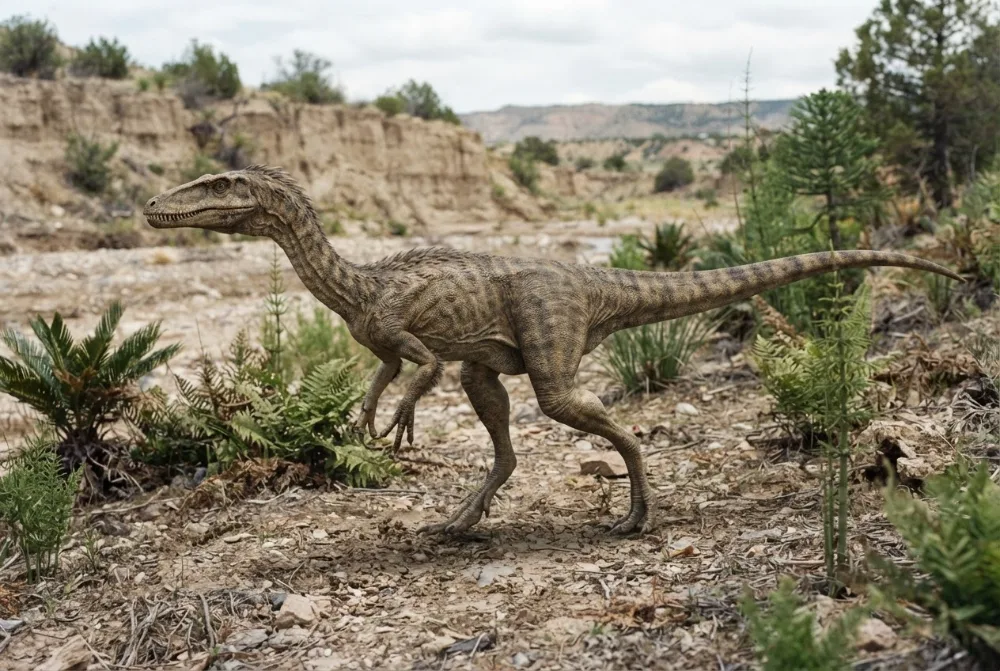
Coelophysis was a small, fast dinosaur that lived in the late Triassic period. It ran on two legs and had sharp teeth for eating meat. Hundreds of its skeletons have been found together in New Mexico, USA.12
When did it live?
How big was it?
How long was it?
How tall was it?
at the hips
How heavy was it?
How big was Coelophysis compared to YOU?
Just maths in your browser. Nothing is saved or sent anywhere.
Fun facts
Coelophysis is one of the earliest known dinosaur genera, living about 215 to 201 million years ago.1
A huge pile of hundreds of Coelophysis skeletons was found at Ghost Ranch in New Mexico in 1947.2
Coelophysis had about 26 teeth in its upper jaw and 27 in its lower jaw.1
Its arms were flexible but weak, so it probably hunted animals much smaller than itself.1
Coelophysis was very light, weighing only about as much as a big dog.2
Some scientists once thought Coelophysis was the same as another dinosaur called Rioarribasaurus, but now most agree they are different.1
Most asked questions about Coelophysis
?How big was Coelophysis?
Coelophysis was small, growing up to about 3 metres (9.8 feet) long. It weighed only about 18 to 23 kg (40 to 50 pounds).12
?What did Coelophysis eat?
Coelophysis was a carnivore, meaning it ate meat. It probably hunted small, fast animals like lizards and early mammal relatives.12
?When did Coelophysis live?
Coelophysis lived during the Late Triassic period, about 215 to 201 million years ago.1
?Where was Coelophysis found?
Coelophysis fossils have been found in the southwestern United States, especially in New Mexico. Similar animals have been found in South Africa and Zimbabwe.13
?How fast could Coelophysis run?
Coelophysis was a fast, agile runner, but scientists don't know its exact speed. It had long legs and a light body to help it run quickly.13
?Why is Coelophysis called Coelophysis?
The name Coelophysis means 'hollow form', because its limb bones were hollow. This made its body light and helped it be a swift hunter.3
?Did Coelophysis have feathers?
Scientists don't know for sure if Coelophysis had feathers. No feathers have been found with its fossils, but some related dinosaurs may have had them.1
?Was Coelophysis bigger than a human?
Coelophysis was about 3 metres (9.8 feet) long, which is longer than a human is tall, but it was very light, weighing only about 18 to 23 kg (40 to 50 pounds).12
?Could Coelophysis swim?
There is no evidence that Coelophysis could swim. It was a land-dwelling dinosaur that ran on two legs.1

Ask Rex about Coelophysis
Rex only answers questions about this page. 3 questions a day.
Rex is an AI and can make mistakes. He runs on servers in the EU and questions are never saved. Never type your name or other personal things.
Myth buster
Myth: Coelophysis swallowed its young whole.
Truth: A fossil once thought to show a baby Coelophysis inside an adult is actually a different reptile or a mistake. There is no proof it ate its own young.1
For dino experts
- Scientific name
- Coelophysis
- Named by
- Cope 18894
- Group
- Meat-eating dinos
- Family / clade
- Coelophysidae4
- Classification
- Theropoda > Coelophysoidea4
- Age of the rocks
- 227 to 193 million years (Norian / Sinemurian)4
- Rock formations
- Chinle, Petrified Forest, Tecovas4
- Countries
- USA4
- Fossil records
- 26 in the Paleobiology Database4
- Also known as
- Rioarribasaurus (older names now counted as the same animal)4
- Discovery
- Edward Drinker Cope named Coelophysis in 1889, based on bones collected by David Baldwin in 1881 from New Mexico, USA.14
- Still debated
- Scientists still debate whether some fossils from other parts of the world belong to Coelophysis or to similar dinosaurs.1
Where the facts come from
- Coelophysis (en.wikipedia.org)
- Coelophysis | Triassic, Carnivore, Reptile | Britannica (britannica.com)
- Coelophysis | Natural History Museum (nhm.ac.uk)
- Coelophysis in The Paleobiology Database (CC BY 4.0): age, places, rock formations, classification.
Every fact on this page has a number that points to its source. If we got something wrong, sorry, we are dino fans, not a science journal. Tell us at [email protected] and we will fix it.
 Rex is hungry! Dino Wiki is a dad's project for his dino-loving son, free with no ads. Grown-ups can feed Rex a snack to help keep it online.Feed Rex
 Allosaurus
 Carnotaurus
 Dilophosaurus
 Giganotosaurus
 Compsognathus
 Paronychodon
 Nothosaurus
 Massospondylus
 Plateosaurus
 Simosaurus
 Thecodontosaurus
 Eudimorphodon