
Anserimimus
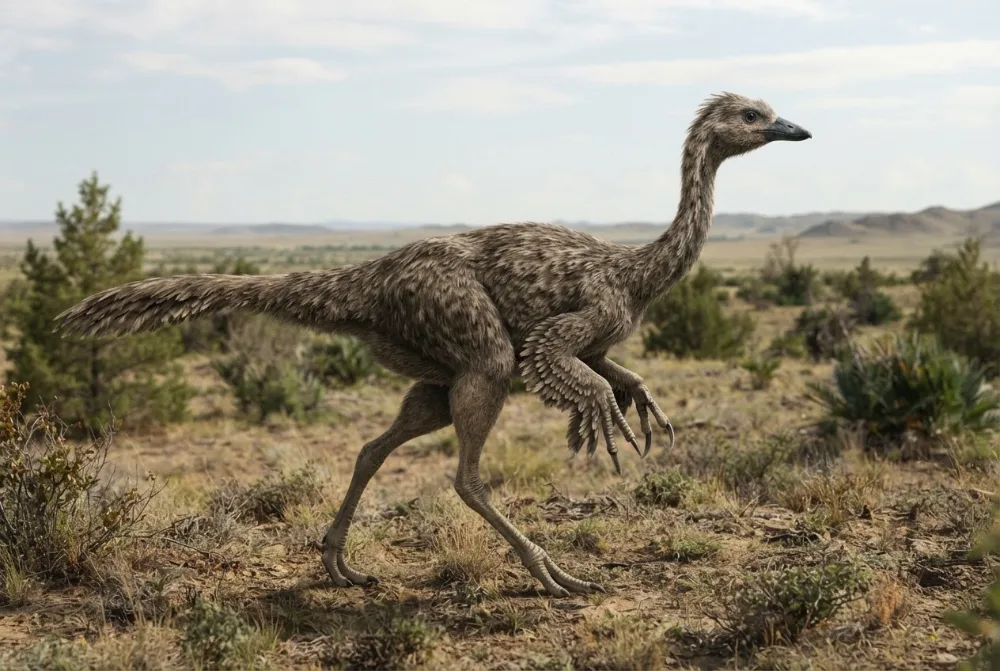
Anserimimus was a fast, long-legged dinosaur that looked a bit like an ostrich. It had strong arms with flat claws, which made it different from its relatives. This dinosaur lived in what is now Mongolia during the Late Cretaceous period.2
When did it live?
How big was it?
How long was it?
How tall was it?
estimate
How heavy was it?
 as long as 4 dogs nose to tail🍌as long as 19 bananas end to end🍉as heavy as 34 watermelons🧸as heavy as 9 kindergarten kids🎒as heavy as 5 school kids🏃could run 100 metres in 5.5 seconds (the fastest human needs 9.6)
How big was Anserimimus compared to YOU?
Just maths in your browser. Nothing is saved or sent anywhere.
How fast was it?


Fun facts
Anserimimus had flat, straight claws on its hands, unlike the curved claws of other ornithomimids.2
Its arms were more powerful than those of other ornithomimids, with large crests for strong muscles like the biceps.2
The hand bones (metacarpals) were fused together, making the hand stronger.2
Anserimimus lived about 70 million years ago, during the Maastrichtian stage of the Late Cretaceous.2
Only one complete skeleton of Anserimimus has been found, and it is missing the skull and lower jaws.2
Its closest relative might be Gallimimus, another ornithomimid from the same formation in Mongolia.2
Anserimimus lived alongside giant dinosaurs like Tarbosaurus and Deinocheirus in the Nemegt Formation.2
Most asked questions about Anserimimus
?How big was Anserimimus?
About 3 metres long and weighed around 50 kilograms, though some estimates suggest up to 170 kilograms.2
?What did Anserimimus eat?
Scientists think it was probably an omnivore, but since its skull is missing, its exact diet is unknown.2
?When did Anserimimus live?
It lived about 70 million years ago, during the Late Cretaceous Period.2
?Why did Anserimimus have flat claws?
Nobody knows for sure. The flat, straight claws may have been used for a different way of gathering food, but the animal's skull is missing so its diet is hard to study.2

Ask Rex about Anserimimus
Rex only answers questions about this page. 10 questions a month.
Rex is an AI and can make mistakes. He runs on servers in the EU and questions are never saved. Never type your name or other personal things.
For dino experts
- Scientific name
- Anserimimus
- Named by
- Barsbold 19884
- Group
- Ostrich dinos
- Family / clade
- Ornithomimidae4
- Classification
- Theropoda > Ornithomimosauria4
- Age of the rocks
- 72 to 66 million years (Maastrichtian)4
- Rock formations
- Nemegt4
- Countries
- Mongolia4
- Fossil records
- 2 in the Paleobiology Database4
- Discovery
- Anserimimus was named by Mongolian paleontologist Rinchen Barsbold in 1988, based on a skeleton found during a Soviet-Mongolian expedition to the Gobi Desert in the late 1970s.2
- Still debated
- Scientists are not sure what Anserimimus ate, because its skull has never been found. Its strong arms and flat claws might mean it had a different diet or way of gathering food than other ornithomimids.2
Where the facts come from
- Anserimimus | Natural History Museum (nhm.ac.uk)
- Anserimimus (en.wikipedia.org)
- PBDB Taxon (paleobiodb.org)
- Anserimimus in The Paleobiology Database (CC BY 4.0): age, places, rock formations, classification.
Every fact on this page has a number that points to its source. If we got something wrong, sorry, we are dino fans, not a science journal. Tell us at [email protected] and we will fix it.
 Rex is hungry! Dino Wiki is a dad's project for his dino-loving son, free with no ads. Grown-ups can feed Rex a snack to help keep it online.Feed Rex
 Gallimimus
 Ornithomimus
 Struthiomimus
 Deinocheirus
 Dromiceiomimus
 Archaeornithomimus
 Tyrannosaurus
 Triceratops
 Velociraptor
 Spinosaurus
 Ankylosaurus
 Parasaurolophus