
Velociraptor
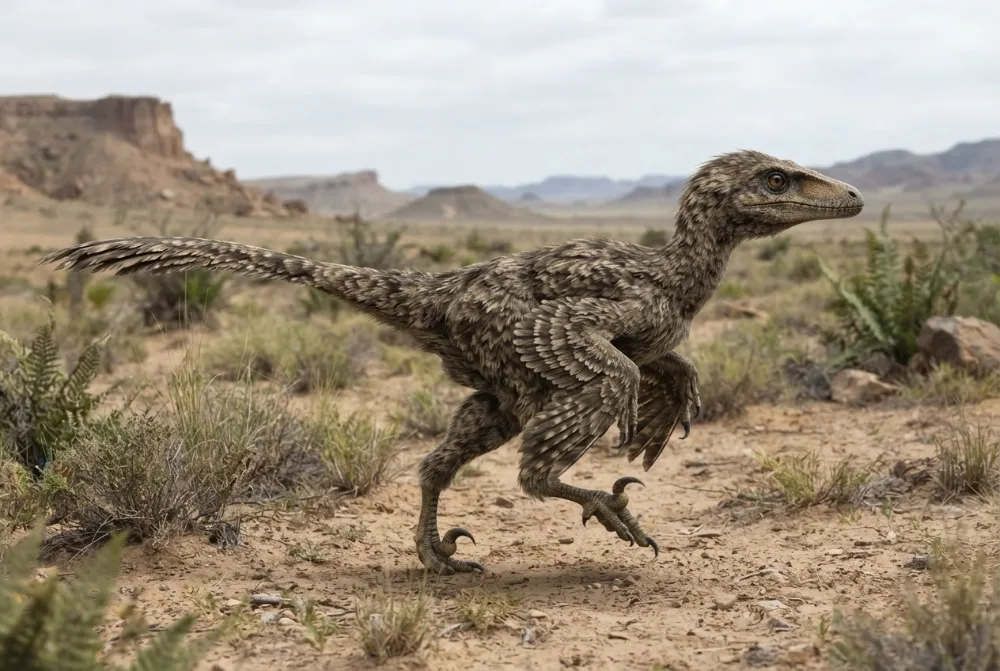
Velociraptor was a small, fast dinosaur that used a huge sickle-shaped claw on each foot to hunt. It lived in the late Cretaceous period, about 74 to 70 million years ago, in what is now Mongolia. Despite what you see in movies, real Velociraptor was only about the size of a turkey and probably had feathers.12
When did it live?
How big was it?
How long was it?
How tall was it?
hip height; range from Wikipedia (0.5 m at hips) and Italian journal (up to 1 m at hip)
How heavy was it?
How big was Velociraptor compared to YOU?
Just maths in your browser. Nothing is saved or sent anywhere.
Fun facts
Velociraptor had a large, sickle-shaped claw on the second toe of each foot, which it used to slash at prey.2
The Velociraptor in Jurassic Park movies was made much larger than the real animal and was actually based on a different dinosaur called Deinonychus.1
Velociraptor is now thought to have been covered in fine, feather-like structures, making it look more like a bird than a scaly reptile.1
The largest Velociraptor grew to about 1.8 metres (6 feet) long, which is about the height of an adult man, but weighed only up to 45 kg (100 pounds).2
Velociraptor lived during the Late Cretaceous period, about 74 to 70 million years ago, and went extinct before the big asteroid hit Earth.12
The name Velociraptor means 'quick plunderer', because it was a fast hunter.1
Most asked questions about Velociraptor
?How big was a Velociraptor?
About 2 metres (6.6 feet) long and weighed around 15 to 20 kilograms (33 to 44 pounds). It was about the size of a large dog.35
?Did Velociraptor have feathers?
Yes. Scientists have found quill knobs on a Velociraptor fossil, which proves it had long feathers on its arms. Its body was covered in feathers, like a bird.56
?Could Velociraptor fly?
No. Its arms were too short and its wishbone was the wrong shape for flying. The feathers were probably used for display and keeping warm.56
?How fast could Velociraptor run?
It could run at speeds up to about 39 km/h (24 miles per hour). Its long legs and light body made it a fast runner.6
?What did Velociraptor eat?
It ate small mammals, reptiles, and possibly baby dinosaurs like young Protoceratops. It was a carnivore that used its claws and teeth to catch prey.5
?When did Velociraptor go extinct?
It died out about 70 million years ago, near the end of the Cretaceous Period. That was before the big asteroid hit Earth.2
?Why did Velociraptor have a sickle claw?
It used the big curved claw on each foot to stab and grip its prey, like an eagle uses its talons. It kept the claw lifted off the ground to stay sharp.56

Ask Rex about Velociraptor
Rex only answers questions about this page. 3 questions a day.
Rex is an AI and can make mistakes. He runs on servers in the EU and questions are never saved. Never type your name or other personal things.
For dino experts
- Scientific name
- Velociraptor
- Named by
- Osborn 19247
- Group
- Raptors
- Family / clade
- Dromaeosauridae7
- Classification
- Theropoda > Dromaeosauridae7
- Age of the rocks
- 90 to 66 million years (Coniacian / Maastrichtian)7
- Rock formations
- Djadokhta, Baruungoyot, Dinosaur Park7
- Countries
- Mongolia, China, Canada, Kazakhstan7
- Fossil records
- 20 in the Paleobiology Database7
- Discovery
- Velociraptor was named by Henry Fairfield Osborn in 1924, based on fossils found in the Gobi Desert of Mongolia.71
- Still debated
- Scientists are still debating exactly how Velociraptor used its sickle claw, whether for slashing or climbing.2
Where the facts come from
- Velociraptor | Natural History Museum (nhm.ac.uk)
- Velociraptor | Description, Size, Diet, & Facts | Britannica (britannica.com)
- Velociraptor (en.wikipedia.org)
- Velociraptor : the state of the art 100 years after the discovery of this iconic dinosaur (italianjournalofgeosciences.it)
- Vicious Velociraptor: tales of a turkey-sized dinosaur | Natural History Museum (nhm.ac.uk)
- Velociraptor, facts and photos | National Geographic (nationalgeographic.com)
- Velociraptor in The Paleobiology Database (CC BY 4.0): age, places, rock formations, classification.
Every fact on this page has a number that points to its source. If we got something wrong, sorry, we are dino fans, not a science journal. Tell us at [email protected] and we will fix it.
 Rex is hungry! Dino Wiki is a dad's project for his dino-loving son, free with no ads. Grown-ups can feed Rex a snack to help keep it online.Feed Rex
 Microraptor
 Deinonychus
 Asiamericana
 Richardoestesia
 Saurornitholestes
 Troodon
 Tyrannosaurus
 Triceratops
 Spinosaurus
 Ankylosaurus
 Parasaurolophus
 Pteranodon