
Diplodocus
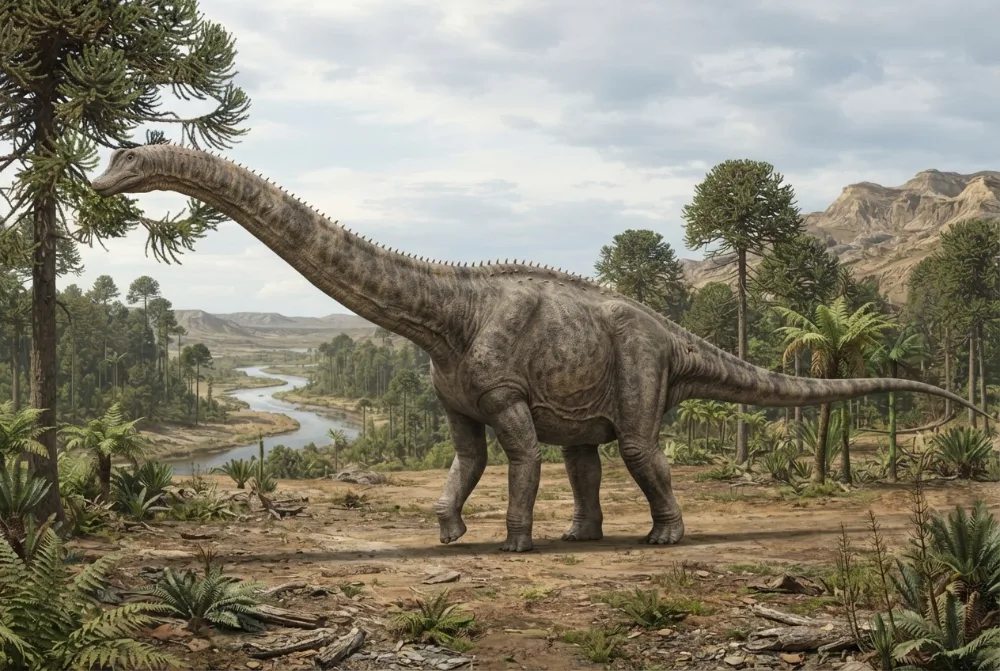
Diplodocus was a super long dinosaur that lived about 150 million years ago. It had a very long neck and an even longer tail, and it used its pencil-like teeth to strip leaves from plants. Despite its huge size, it was lighter than many other giant sauropods.21
When did it live?
How big was it?
Fun facts
Diplodocus had about 80 vertebrae in its tail alone, which made up almost one third of its entire body length.1
Its tail was very long and whip-like, and scientists think it might have been used to make loud cracking sounds to scare off predators.2
Diplodocus had narrow, pointed bony spines lining its back, which may have helped support its body.2
Ligaments running from its hip to the back of the neck helped Diplodocus hold its neck horizontally without using much muscle effort.2
An Apatosaurus of similar size would have weighed two to three times more than a Diplodocus, because Diplodocus was lightly built.1
Diplodocus lived in a hot, dry environment like a savannah, alongside dinosaurs such as Allosaurus, Brontosaurus, and Stegosaurus.2
Myth buster
Myth: Some people think Diplodocus held its neck straight up like a giraffe.
Truth: Scientists now believe that Diplodocus held its neck horizontally, supported by strong ligaments, not upright.2
For dino experts
- Scientific name
- Diplodocus
- Named by
- Marsh 18783
- Group
- Long-necks
- Family / clade
- Diplodocidae3
- Classification
- Sauropodomorpha > Sauropoda > Diplodocoidea3
- Age of the rocks
- 158 to 143 million years ()3
- Rock formations
- Morrison3
- Countries
- USA3
- Fossil records
- 66 in the Paleobiology Database3
- Also known as
- Seismosaurus (older names now counted as the same animal)3
- Discovery
- Diplodocus was first described in 1878 by paleontologist Othniel Charles Marsh during the 'Bone Wars', a fierce competition between fossil hunters.13
- Still debated
- Scientists still debate whether Diplodocus could crack its tail like a whip to make a loud sound, or if it was used for other purposes.2
Where the facts come from
- Diplodocus longus - Dinosaur National Monument (U.S. National Park Service) (nps.gov)
- Diplodocus | Natural History Museum (nhm.ac.uk)
- Diplodocus in The Paleobiology Database (CC BY 4.0): age, places, rock formations, classification.
Every fact on this page has a number that points to its source. If we got something wrong, sorry, we are dino fans, not a science journal. Tell us at [email protected] and we will fix it.
 Rex is hungry! Dino Wiki is free with no ads. Grown-ups can feed Rex a snack to keep it that way.Feed Rex
 Brachiosaurus
 Brontosaurus
 Argentinosaurus
 Camarasaurus
 Morosaurus
 Massospondylus
 Allosaurus
 Compsognathus
 Camptosaurus
 Nanosaurus
 Rhamphorhynchus
 Ceratosaurus