
Brachiosaurus
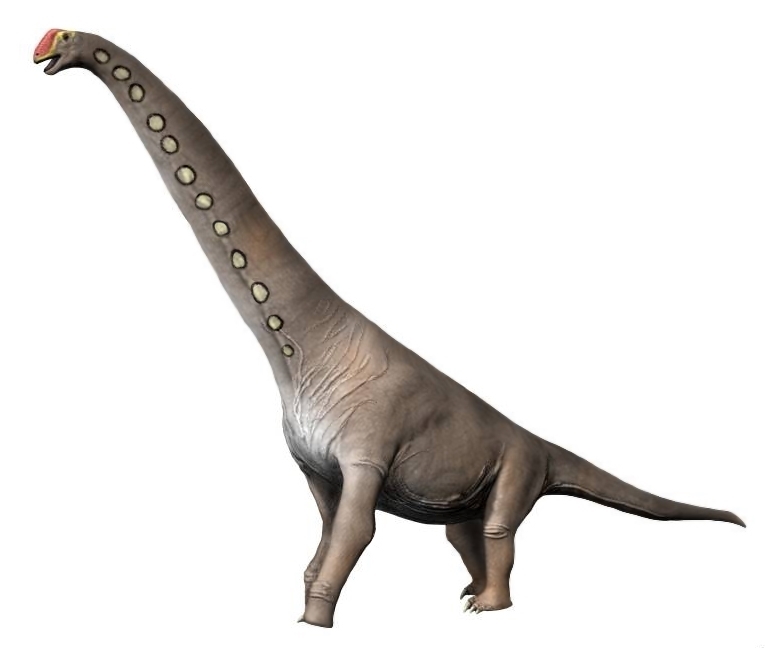
Brachiosaurus was a giant, long-necked dinosaur that ate plants. It had front legs that were longer than its back legs, like a giraffe. This helped it reach high into trees to munch on leaves.1
When did it live?
How big was it?
Fun facts
Brachiosaurus had front legs that were longer than its back legs, which is unusual for sauropods. This gave it a sloping back like a giraffe.1
It could reach food up to 9 meters (30 feet) off the ground, higher than most other dinosaurs.1
Brachiosaurus had air sacs in its neck and body that made it lighter. These sacs were connected to its lungs.1
The first Brachiosaurus fossil was found in 1900 near Fruita, Colorado, USA. It was named by Elmer S. Riggs in 1903.1
Many pictures of Brachiosaurus are actually based on a different dinosaur called Giraffatitan, which lived in Africa.1
Brachiosaurus lived during the Late Jurassic period, about 155 to 145 million years ago.1
Scientists think Brachiosaurus ate about 200 to 400 kilograms (440 to 880 pounds) of plants every day.1
Myth buster
Myth: Brachiosaurus could rear up on its hind legs like other sauropods.
Truth: Unlike many sauropods, Brachiosaurus was not built to rear up on its hind legs because of its long front legs and short tail.1
For dino experts
- Scientific name
- Brachiosaurus
- Named by
- Riggs 19032
- Group
- Long-necks
- Family / clade
- Brachiosauridae2
- Classification
- Sauropodomorpha > Sauropoda > Macronaria2
- Age of the rocks
- 158 to 143 million years ()2
- Rock formations
- Morrison, Tendaguru, Kadzi2
- Countries
- USA, Tanzania, Zimbabwe, Germany2
- Fossil records
- 20 in the Paleobiology Database2
- Discovery
- Brachiosaurus was discovered in 1900 by Elmer S. Riggs and his crew in the Colorado River valley near Fruita, Colorado. Riggs named it Brachiosaurus altithorax in 1903.1
- Still debated
- Scientists still debate whether Brachiosaurus was warm-blooded or cold-blooded. Its huge size makes it hard to tell.1
Where the facts come from
- Brachiosaurus (en.wikipedia.org)
- Brachiosaurus in The Paleobiology Database (CC BY 4.0): age, places, rock formations, classification.
Every fact on this page has a number that points to its source. If we got something wrong, sorry, we are dino fans, not a science journal. Tell us at [email protected] and we will fix it.
 Rex is hungry! Dino Wiki is free with no ads. Grown-ups can feed Rex a snack to keep it that way.Feed Rex
 Diplodocus
 Brontosaurus
 Argentinosaurus
 Camarasaurus
 Morosaurus
 Massospondylus
 Allosaurus
 Compsognathus
 Camptosaurus
 Nanosaurus
 Rhamphorhynchus
 Ceratosaurus